
Introduction to IT Service Management: Navigating the Digital Tide

In the ever-evolving landscape of technology, IT Service Management (ITSM) isn’t just riding the wave; it’s making them. Over the last decade, ITSM has transformed from a sturdy raft to a formidable ship, steering businesses through the digital seas. With Agile methodologies as its compass and Artificial Intelligence (AI) as its sail, ITSM is revolutionizing how IT services are delivered and managed.
Glossary
- ITSM (IT Service Management): The art and science of designing, delivering, managing, and refining the IT services that organizations provide to their users.
- DevOps: A blend of development and operations, this practice is about breaking down silos and speeding up the software lifecycle – think of it as a tech tango that keeps systems dancing smoothly.
- AI (Artificial Intelligence): More than just a buzzword, it’s about giving machines a brainy upgrade to think, learn, and maybe one day tell jokes.
- BYOD (Bring Your Own Device): The modern-day mantra of ‘bring your tech to work’, because who doesn’t love using their own gadgets?
- ITAM (IT Asset Management): Like a treasure map for IT assets, ensuring every piece of tech gold is well accounted for, from acquisition to retirement.
- IoT (Internet of Things): A tech jamboree where everyday objects get chatty over the internet, making life a bit more sci-fi.
- NLP (Natural Language Processing): Teaching computers to understand human language, because sometimes, even humans struggle with it.
The Evolution of IT Service Management Over the Last Decade

- DevOps: Bridging Development and Operations: Picture a world where the dev team’s new software features are as eagerly awaited as the finale of your favorite TV show, and thanks to DevOps, they’re delivered just as fast. Netflix, for instance, is a DevOps maestro, making sure that binge-watching is never interrupted by tech hiccups.
- AI: The New ITSM Crew Member: AI in ITSM is like having a super-smart sidekick who’s always one step ahead. Take IBM’s AI-powered IT service desk assistant – it’s like having a tech Sherlock Holmes on your team, solving IT mysteries before they become problems.
- Mobile Technology: Steering the Ship from Anywhere: Imagine being on a tropical island and still being able to solve IT crises with just a few taps on your smartphone. That’s mobile ITSM for you – turning every palm tree into a potential office.
- IT Asset Data: Charting the Course: Integrating ITSM with ITAM is like having a GPS for all your IT assets. Universities, swarming with tech, use it to keep everything from laptops to projectors in check, making sure the tech tide is always high.
- Service Portals: The Lighthouse of Information: Think of service portals as your ITSM Google. Need help? Have a question? Just ask the portal. Companies like ServiceNow have turned these portals into ITSM’s front desk, always ready to assist.
Current Trends in IT Service Management

- Employee-Centric IT: A Change Driver: Businesses are now putting employees in the IT driver’s seat. Google, for example, has turned its IT environment into a digital Disneyland, filled with tools that make work feel a bit less like work and a bit more like fun.
- Data-Driven ITSM Operations: Amazon is playing the ITSM game like a grandmaster, using data-driven strategies to foresee and checkmate IT issues, ensuring that the only ‘down’ in ‘downtime’ is when you’re chilling on your couch.
- ITSM Benefit Amplification Through Intelligent Automation: IBM’s Watson AI isn’t just playing chess; it’s also automating ITSM processes, making sure that IT services are as smooth as a jazz solo.
- Enterprise Service Management: Beyond IT: Siemens is taking ITSM beyond its traditional borders, applying its principles to HR and facilities, proving that ITSM isn’t just for the techies.
- Optimizing Operations, Assets, and Experiences: Microsoft is using ITSM like a magic wand, optimizing everything in its path, ensuring that their software and services are not just good but ‘wizard-level’ great.
- Reinvention of Self-Help: Salesforce’s AI-driven IT self-help system is like having a genie in your computer – just make a wish (or rather, ask a question), and poof, you have your answer.
- Focus on Employee Well-Being: SAP knows that a happy IT team is a productive IT team, which is why they’ve turned their ITSM strategy into a well-being wonderland, full of resources to keep stress at bay.
- Personalized IT Support: Adobe is making IT support as personal as your morning coffee, using ITSM tools to know just how you like your tech.
- Business-Value Focus in ITSM: Dell Technologies is proving that good ITSM is good business, linking IT service improvements directly to customer smiles and sales.
- Sustainability in ITSM: Apple’s 100% renewable energy-powered data centers show that ITSM isn’t just about bytes and bandwidth; it’s also about being kind to our planet.
Adapting to Evolving IT Service Management Practices
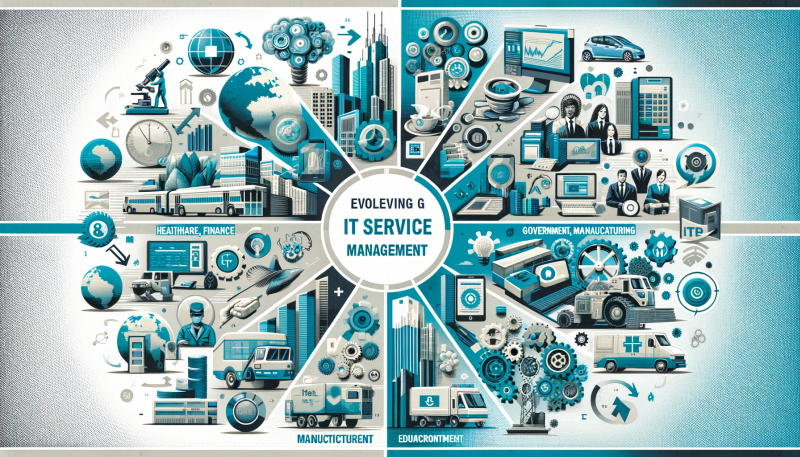
1. Healthcare: Enhancing Patient Care with ITSM
The healthcare industry, exemplified by the Mayo Clinic, is leveraging ITSM to manage patient records and administrative processes more efficiently. Their integrated IT systems allow quick access to patient data, leading to faster and more accurate diagnoses, crucial in enhancing patient care and operational efficiency.
2. Finance: Securing Data and Improving Services
Banks and financial institutions, like JPMorgan Chase, are adopting advanced ITSM practices for enhanced security and customer service. They use real-time transaction monitoring and fraud detection tools to offer personalized customer services and automate responses for high-volume transactions.
3. Retail: Personalizing Customer Experiences
Retailers such as Walmart are utilizing ITSM to offer personalized shopping experiences by managing online platforms and inventory through data analytics. This approach enables retailers to predict customer preferences and trends, ensuring seamless shopping experiences across various channels.
4. Manufacturing: Streamlining Production Processes
In manufacturing, companies like Siemens are using ITSM tools integrated with production systems to monitor and optimize operations. This leads to reduced downtime and improved product quality, instrumental in streamlining production processes and supply chain management.
5. Education: Enhancing Learning and Administration
Educational institutions, including Harvard University, are adopting ITSM to manage online learning platforms and student information systems. This ensures that educational services are accessible and effective, enhancing the learning experience and administrative efficiency.
6. Government: Improving Public Services
Government agencies, exemplified by the United States Postal Service (USPS), are utilizing ITSM to manage public information systems and provide efficient citizen services online. This approach enhances the reliability and accessibility of public services and improves internal operations.
7. Telecommunications: Ensuring Connectivity and Service Quality
Telecom companies, like Verizon, use ITSM tools to manage and monitor network performance. This ensures high-quality services and rapid resolution of connectivity issues, essential in maintaining customer satisfaction and service continuity.
8. Transportation: Enhancing Operational Efficiency
In the transportation sector, companies such as FedEx are using ITSM for logistics and fleet management. Real-time data from ITSM tools helps optimize routes, reduce operational costs, and improve customer satisfaction with timely and efficient deliveries.
These examples across various sectors illustrate the practical application and impact of ITSM practices, showcasing how they are leveraged for efficiency, innovation, and improved service delivery in the modern business landscape.
Conclusion

As we sail into the future, ITSM isn’t just a part of the business ship; it’s becoming the captain. It’s turning organizations into digital Davids, ready to take on the Goliaths of tomorrow. Whether you’re just dipping your toes into the ITSM waters or you’re ready to dive deep, remember, in this sea of technology, ITSM is your best lifejacket. So, suit up, and let’s make some waves!
Bibliography
- “5 Beneficial Ways ITSM Has Evolved Over the Last Decade.” Orange Matter. [https://orangematter.solarwinds.com/].
- “Top 10 ITSM Trends to Watch Out for in 2023.” Invgate Blog. [https://blog.invgate.com/].
- “IT service management: How IT tools and practices are evolving.” TechBeacon. [https://www.techbeacon.com/].
- Additional industry-specific examples and insights were gathered from various sources to provide a comprehensive overview of ITSM practices across different sectors.
Thank you for accompanying me on this journey through the dynamic world of IT Service Management. I wish you the best of luck in applying these insights and strategies to your own ITSM initiatives.
